

Choosing your child's football boots can feel surprisingly difficult, and it's one of the questions we're asked most often by parents at SS United FC. The reassuring news is that the decision becomes straightforward once you understand what truly matters. Three factors do most of the work: a correct fit, genuine comfort, and the right studs for the surface your child plays on. Get these right, and your child can focus entirely on enjoying their football rather than worrying about their feet.
Begin with the fit:
Before considering brand, colour or styling, prioritise the fit. It is the foundation of your child's comfort, safety and confidence on the pitch, and it involves more than simply matching their everyday shoe size. Growing feet require particular care to avoid blisters, cramped toes and the discomfort that can quickly take the enjoyment out of a match.
Children's feet develop rapidly - often by half a size within a few months. So it's wise not to assume last season's boots will still be suitable. The most common mistake we see is purchasing boots a size or two too large in the hope the child will "grow into them." It's an understandable instinct given how quickly boots are outgrown, but oversized boots allow the foot to slide, leading to blisters, instability and reduced confidence in movement.
The ideal is a snug yet supportive fit, with roughly a thumb's width of space beyond the longest toe. This allows for natural movement and a little growing room without the boot feeling loose. It's also worth having your child walk or jog in them: the heel should feel secure, with minimal slipping.
Match the boot to the playing surface:
Once the fit is right, attention turns to the sole - a particularly important consideration in the UK, where pitches vary enormously between firm summer grass and heavy winter mud. Studs are designed for specific surfaces, and choosing the wrong type can affect not only performance but also safety, increasing the risk of slips and strain on the ankles and knees.
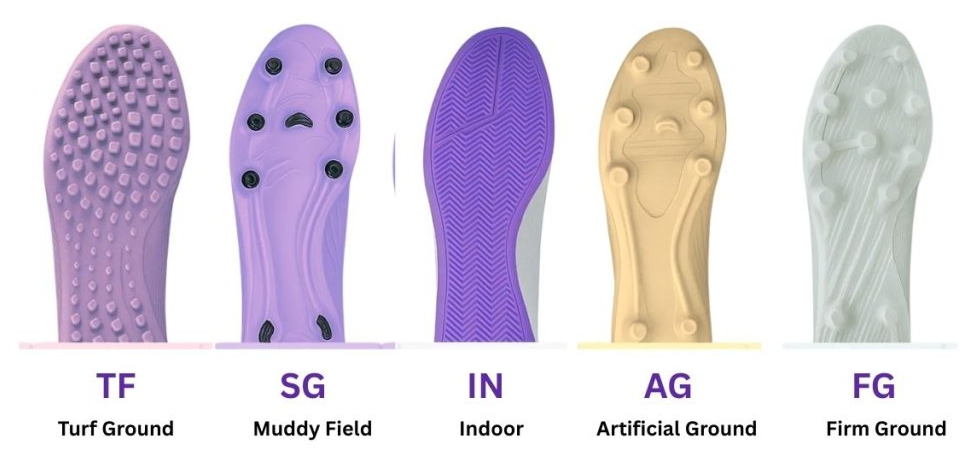
The lettering on the box is simple to decode once you know it:
FG (Firm Ground): The most common option, designed for dry, firm natural grass. A dependable all-rounder for most grassroots football.
AG (Artificial Grass): Made for modern 3G and 4G surfaces, with shorter, more numerous studs. Increasingly relevant as more clubs and schools move to artificial pitches.
SG (Soft Ground): Suited to wet, muddy winter pitches, with longer studs for added grip. Often metal-tipped, and metal studs are frequently restricted in youth football, so we’d encourage parents to opt out for moulded studs for younger players and always check what your league and age group permit.
TF (Turf/Astro): A pimpled rubber sole for older sand-based astroturf and hard training surfaces.
IN (Indoor): Flat, non-marking soles for sports halls and futsal.
One point we always emphasise to parents: avoid using firm-ground (FG) boots on a 3G artificial pitch. The longer studs cannot penetrate the surface properly, creating uncomfortable pressure underfoot and, more significantly, a risk of the foot catching during turns - placing unnecessary strain on developing joints. If your child plays predominantly on artificial surfaces, a dedicated AG pair is a worthwhile investment.
Leather or synthetic?
For most children, synthetic boots are the practical choice. They are lighter, more resistant to everyday wear, don't absorb water in wet conditions, and are easily wiped clean - a welcome advantage at the end of a busy weekend. Leather offers a softer feel and moulds to the foot over time, but requires more maintenance and becomes heavy when wet. For a growing player likely to outgrow their boots within a season, synthetic generally offers the better balance of comfort, durability and value.
Matching features to your child's age and stage:
A child taking their first steps at one of our Saturday sessions has very different needs from an older player competing in regular matches. As a general guide:
Ages 4 to 7: Prioritise simplicity and comfort. Velcro fastenings allow children to manage their own boots, while soft uppers, short moulded studs and a flexible sole suit developing feet. At this stage, enjoyment and confidence with the ball matter far more than performance features.
Ages 8 to 12: Laces typically replace Velcro, and stud patterns become more defined to support sharper movement. A secure, stable boot can make a real difference to a child's willingness to try new skills.
Ages 13 and over: Players competing more seriously often prefer lighter, performance-oriented boots closer to adult models. Even so, fit and surface should remain the priority.
Completing the kit:
While boots take centre stage, a few additional items are essential. Shin pads are mandatory in organised football and the most important protection after the boots themselves; they should sit comfortably between ankle and knee without restricting movement. Proper football socks - long enough to secure shin guards and designed to manage moisture; they are also well worth choosing over standard cotton alternatives, as they help prevent blisters during longer sessions.
A final word:
The most important message we share with parents is this: a higher price does not necessarily mean a better boot for a child. Premium, elite-level boots are engineered to give professional players marginal performance gains that are unnecessary for a young player still developing the fundamentals. A good-quality, mid-range boot that fits correctly and suits the playing surface will serve your child far better than the latest model endorsed by a Premier League star. The fit and the studs are where your attention, and your budget, are best directed.
At SS United FC, we believe every child deserves to feel confident and comfortable when they step onto the pitch, because a settled, happy player is one who is free to develop a genuine love for the game. From a first kick-about at four to competitive football at sixteen, we are here to support every stage of your child's journey, whatever boots they wear.
If your child is ready to begin or take their next step, we would be delighted to welcome them. We cater for all abilities, from complete beginners to aspiring players, and the first session is a free trial - so there's nothing to lose. ⚽🌟
Please note: This guidance is general in nature. Stud regulations and kit requirements can vary between leagues and age groups, so please check the specific rules that apply to your child’s team before purchasing.